Complex and interdisciplinary orthodontics
Complex and interdisciplinary orthodontics in Broomfield, CO
Coordinated care for skeletal bite problems and adult expansion
Written by Dr. Irina Sharp, board-certified orthodontist. Last reviewed September 2026.
Some orthodontic problems involve more than the position of the teeth. A narrow upper jaw, a significant difference between the upper and lower jaws, facial asymmetry, or a severe open bite may reflect the underlying skeletal structure. In these situations, braces or clear aligners alone may not fully address the diagnosis.
At Sharp Smiles Orthodontics, Dr. Irina Sharp evaluates the teeth, roots, bite, jaw relationships, facial balance, supporting bone and gum health, and the patient's goals before recommending treatment. Depending on the findings, a plan may include miniscrew-assisted rapid palatal expansion, temporary anchorage devices, orthognathic surgery, or coordinated care with other specialists.
Complex treatment does not mean that every patient needs surgery. It means the diagnosis deserves a careful discussion of what orthodontics can change, what it cannot change predictably, and which options best match the patient's priorities.
When is an orthodontic case considered complex?
A case may require advanced planning when the bite problem is driven partly or primarily by the size, width, position, or asymmetry of the jaws. Examples include:
- A skeletally narrow upper jaw in a late adolescent or adult
- A significant underbite or excessive overjet related to jaw position
- A severe open bite with a skeletal component
- Facial or jaw asymmetry
- A bite discrepancy that cannot be corrected predictably by moving the teeth alone
- Impacted teeth or missing teeth requiring complex space management
- Orthodontic preparation for restorative, periodontal, or prosthetic treatment
- A need for skeletal anchorage to move teeth while limiting unwanted movement elsewhere
The same visible bite can have different causes. Accurate diagnosis is what separates an appropriate advanced treatment plan from an unnecessarily complicated one.
How are complex cases evaluated?
Planning begins with a clinical examination and diagnostic records. At your consultation, we typically take facial and smile photographs, a 3D digital scan of your teeth with an iTero scanner, and 3D imaging to evaluate the teeth, roots, and jaws in detail. Depending on the question being evaluated, panoramic and cephalometric radiographs may also be used when their diagnostic value justifies the additional exposure.
We evaluate whether the discrepancy is dental, skeletal, or a combination of both. We also consider growth status, periodontal support, tooth position within the bone, previous treatment, missing or restored teeth, facial proportions, airway symptoms, and the patient's tolerance for different levels of treatment.
When surgery or another specialist is being considered, early coordination matters. The orthodontist and specialist should agree on the diagnosis and treatment objectives before irreversible steps are taken.
What is MARPE?
MARPE stands for miniscrew-assisted rapid palatal expansion. It is designed to widen a skeletally narrow upper jaw by directing expansion forces through temporary anchorage devices placed in the palate. Depending on the appliance design, the expander may be supported primarily by the palate or by a combination of palatal miniscrews and teeth.
Traditional tooth-borne expanders are most predictable in growing patients whose palatal sutures are more responsive. MARPE may allow skeletal expansion in selected late adolescents and adults while reducing the amount of force placed on the teeth. It is less invasive than surgically assisted expansion, but it is not guaranteed to open the midpalatal suture in every patient.
What problems may MARPE address?
MARPE may be considered when a patient has a true transverse deficiency of the upper jaw. Findings may include:
- A unilateral or bilateral posterior crossbite related to maxillary width
- Upper and lower dental arches that cannot be coordinated without skeletal expansion
- Crowding that is partly associated with a narrow maxilla
- A high or narrow palatal form accompanied by a confirmed transverse discrepancy
- A need to create a more appropriate skeletal foundation before comprehensive orthodontic treatment
Crowding alone does not establish a need for MARPE. The decision should be based on the skeletal diagnosis, periodontal boundaries, age and maturation, appliance design, and the alternatives available.
How does MARPE compare with other expansion options?
The appropriate expansion method depends on skeletal maturity, the severity and location of the deficiency, periodontal support, and the amount of change required.
| Approach | Typical role | Important limitations |
|---|---|---|
| Traditional palatal expander | Commonly used in growing patients when the maxillary sutures are more responsive. | In mature patients, it may create more dental tipping than skeletal expansion. |
| MARPE | Uses palatal miniscrews to pursue nonsurgical skeletal expansion in selected late adolescents and adults. | Suture opening is not guaranteed. Success depends on anatomy, maturation, design, placement, and protocol. |
| Surgically assisted expansion | Uses surgical release to reduce resistance when nonsurgical expansion is not appropriate or has insufficient predictability. | Involves an oral and maxillofacial surgeon, surgical risks, recovery, and additional coordination. |
| Orthognathic surgery | Repositions one or both jaws when the problem extends beyond transverse width or requires comprehensive skeletal correction. | Major surgery with individualized risks, recovery, and medical insurance considerations. |
- Traditional palatal expander
- Typical role: Commonly used in growing patients when the maxillary sutures are more responsive.
- Important limitations: In mature patients, it may create more dental tipping than skeletal expansion.
- MARPE
- Typical role: Uses palatal miniscrews to pursue nonsurgical skeletal expansion in selected late adolescents and adults.
- Important limitations: Suture opening is not guaranteed. Success depends on anatomy, maturation, design, placement, and protocol.
- Surgically assisted expansion
- Typical role: Uses surgical release to reduce resistance when nonsurgical expansion is not appropriate or has insufficient predictability.
- Important limitations: Involves an oral and maxillofacial surgeon, surgical risks, recovery, and additional coordination.
- Orthognathic surgery
- Typical role: Repositions one or both jaws when the problem extends beyond transverse width or requires comprehensive skeletal correction.
- Important limitations: Major surgery with individualized risks, recovery, and medical insurance considerations.
What happens during MARPE treatment?
After the appliance and miniscrews are placed, the expander is activated according to an individualized schedule. Patients commonly notice pressure in the palate, teeth, nose, or cheek areas. A space may develop between the upper front teeth when the suture opens; this is an expected treatment sign in many, but not all, expansion protocols.
The expansion phase is followed by a retention period while bone forms in the expanded area. Braces or clear aligners may then be used to align the teeth, manage the temporary space, coordinate the bite, and complete treatment. See braces and Invisalign.
The activation schedule should not be changed without instructions. Faster activation does not guarantee a better result and may increase discomfort or unwanted effects.
What are the risks and limitations of MARPE?
MARPE is an advanced orthodontic procedure with meaningful benefits for selected patients, but it also has limitations and potential complications. These may include:
- Failure or incomplete opening of the midpalatal suture
- Asymmetric expansion
- Dental tipping or movement outside the intended position
- Inflammation, irritation, or ulceration of palatal tissue
- Loosening or mechanical failure of a miniscrew or appliance component
- Periodontal changes, discomfort, or the need to modify or discontinue the approach
- Some relapse after expansion and the need for adequate retention
If nonsurgical expansion does not succeed or is not sufficiently predictable, surgically assisted expansion may be the safer or more effective option. This possibility should be discussed before MARPE begins.
Does MARPE improve breathing or sleep apnea?
MARPE changes the width of the maxilla and may increase dimensions in parts of the nasal cavity and nasopharynx. Some patients also report a change in nasal breathing. However, current research is heterogeneous, long-term data are limited, and an anatomical change on imaging does not establish that obstructive sleep apnea has been treated.
We do not use a CBCT image alone to diagnose sleep apnea, and we do not present MARPE as a stand-alone cure for a sleep disorder. Patients with habitual snoring, witnessed pauses in breathing, daytime sleepiness, or other concerning symptoms should be evaluated by the appropriate medical or sleep specialist. Orthodontic treatment can then be coordinated with that broader diagnosis when relevant.
Questions about your own treatment plan?
What are temporary anchorage devices?
Temporary anchorage devices, often called TADs or orthodontic miniscrews, are small devices placed in bone to provide a stable point of support during tooth movement. MARPE uses miniscrews to support expansion, but TADs can also be used for other complex movements.
Depending on the plan, TADs may help intrude teeth, close spaces, correct an open bite, manage asymmetry, or reduce unwanted movement of other teeth. They are temporary and are removed when they have completed their role. Not every complex case requires them.
What is orthognathic surgery?
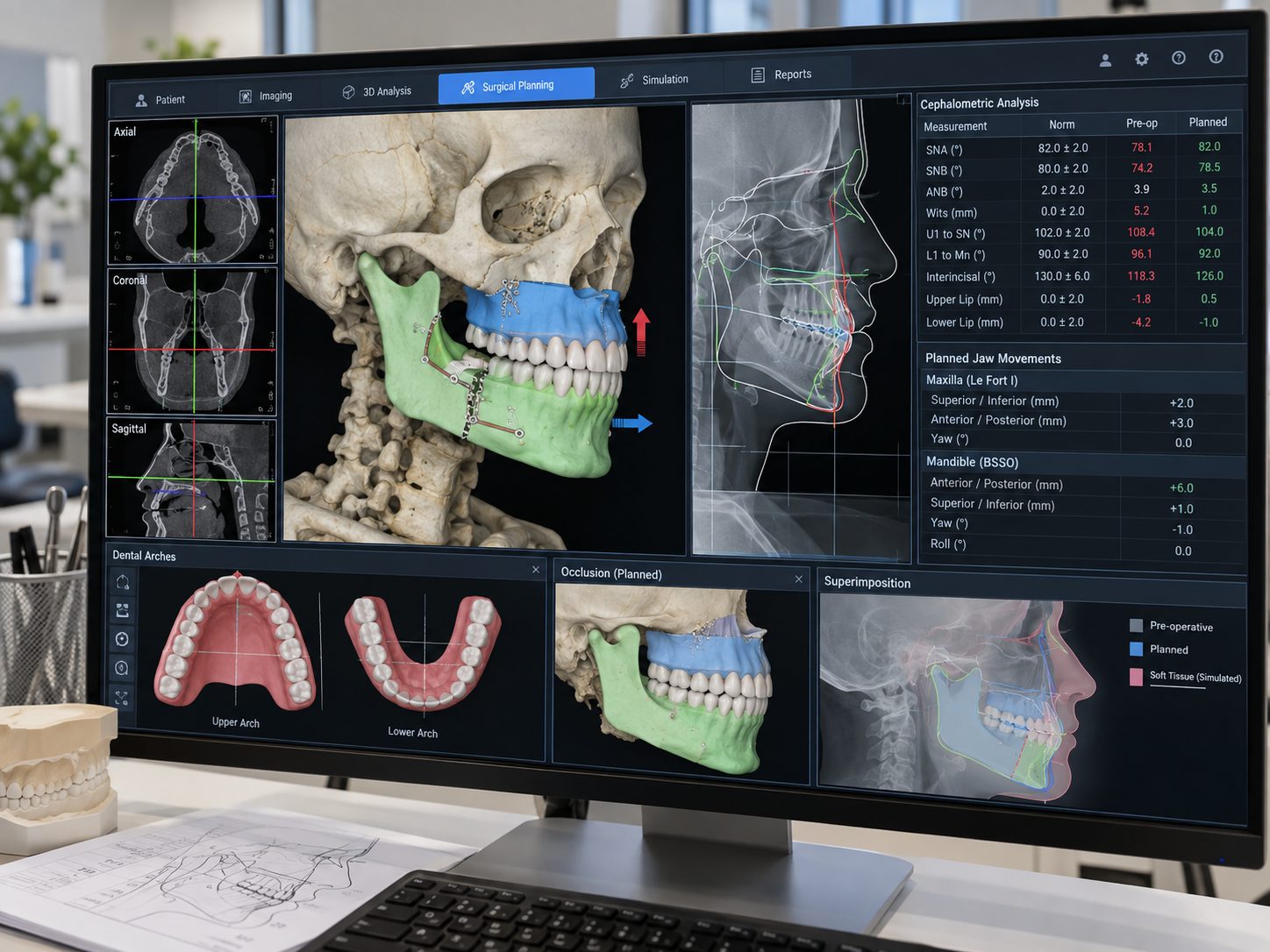
Orthognathic surgery, also called corrective jaw surgery or surgical orthodontics, repositions one or both jaws when the underlying skeletal relationship cannot be corrected predictably with tooth movement alone. The surgery is performed by an oral and maxillofacial surgeon, while the orthodontist positions the teeth so they will fit appropriately after the jaws are repositioned.
Surgical treatment may be considered for significant jaw discrepancies, facial asymmetry, severe skeletal open bite, or other conditions in which orthodontic camouflage would create an unacceptable functional, periodontal, or facial compromise.
How do I know whether I need jaw surgery?
A recommendation for surgery is based on the diagnosis and the limits of nonsurgical treatment, not simply on how severe the teeth look. During planning, we discuss:
- Which part of the problem comes from the teeth and which part comes from the jaws
- What orthodontic treatment alone could reasonably accomplish
- Whether camouflage would move teeth outside healthy or stable boundaries
- Expected functional and facial differences between surgical and nonsurgical options
- The commitment, recovery, costs, and risks associated with each approach
Some patients choose a nonsurgical compromise after understanding its limitations. Others decide that correcting the skeletal foundation is the most appropriate path. The consultation should provide enough information for that decision to be deliberate rather than pressured.
What happens before and after jaw surgery?
Surgical orthodontic care commonly follows several coordinated stages:
Diagnosis and team planning. The orthodontist and oral and maxillofacial surgeon establish shared treatment objectives and review the proposed sequence.
Presurgical orthodontics. Braces or clear aligners position the teeth within each jaw so the arches can fit together after surgery. This decompensation can temporarily make the bite or facial imbalance look more noticeable.
Surgical planning and surgery. The surgeon finalizes the operative plan and discusses the procedure, hospitalization or surgical setting, risks, diet, and recovery.
Postsurgical orthodontics. After the surgeon confirms appropriate healing, orthodontic treatment refines the bite and tooth positions.
Retention. Retainers help protect the final tooth positions after active treatment is complete.
Some teams use a surgery-first sequence in selected cases, but it is not appropriate for every diagnosis. The sequence is chosen jointly by the orthodontist and surgeon.
Who is involved in complex treatment?
Complex care is often interdisciplinary. The team may include:
- The orthodontist, who diagnoses the bite, positions the teeth, and coordinates the orthodontic sequence
- An oral and maxillofacial surgeon, who evaluates and performs jaw or surgically assisted expansion procedures
- The general dentist, who maintains dental health throughout treatment
- A periodontist or restorative dentist when gum support, missing teeth, implants, or restorations affect planning
- An ENT physician or sleep-medicine clinician when nasal obstruction or sleep-disordered breathing requires medical evaluation
The specialists do not work in isolation. Shared records, clearly defined responsibilities, and agreement on the final goals help reduce surprises as treatment progresses.
How long does complex orthodontic treatment take?
There is no single timeline for MARPE or surgical orthodontics. Treatment length depends on the diagnosis, growth and maturation, the expansion or surgical approach, healing, tooth movement, periodontal health, and whether additional treatment stages are required.
After the diagnostic workup and specialist consultations, we can provide an individualized estimate and identify the parts of the schedule that are least predictable. The timeline may change if the biological response, surgical timing, or treatment objectives change.
What does complex orthodontic treatment cost?
Fees for complex treatment vary widely because the diagnosis, appliance, and any surgical involvement differ from patient to patient. Surgical fees for the surgery itself are set separately by the oral and maxillofacial surgeon's office.
- Dental and medical insurance: orthodontic treatment is typically billed under dental benefits, while jaw surgery is often eligible for medical insurance coverage.
- HSA and FSA: accepted
Our approach to complex cases
At Sharp Smiles Orthodontics, advanced technology supports the diagnosis; it does not replace clinical judgment. We use records to define the skeletal and dental problem, establish realistic treatment goals, and communicate with the specialists involved.
We also make room for the patient's priorities. Questions about surgery, appearance, breathing, recovery, cost, treatment length, alternatives, and long-term stability are appropriate and important. Our goal is to explain what each option can and cannot predictably accomplish so the patient can make an informed decision.
We look early so you don’t have to wonder later.
Looking for something else?
Questions
Before you book
Will I definitely need surgery?
Not necessarily. Many patients referred for a complex evaluation are treated successfully with MARPE, TADs, or coordinated non-surgical approaches. Surgery is recommended only when the diagnosis shows it is the most appropriate path.
Is MARPE painful?
Most patients notice pressure in the palate, teeth, nose, or cheeks during activation, rather than sharp pain. Over-the-counter pain relief used as directed, along with soft foods during the most active days of expansion, can help. Contact us if the discomfort is sharp, severe, or doesn't ease between activations.
Who places the miniscrews for MARPE or TADs?
Dr. Sharp does.
Does insurance cover jaw surgery?
Jaw surgery is often eligible for medical insurance coverage, separate from typical dental orthodontic benefits. We can help clarify which portions of your treatment may qualify.
Can a child need this kind of evaluation?
Most complex skeletal cases discussed here involve late adolescents and adults, but some jaw growth concerns are identified earlier. See early orthodontic treatment.
Do I need a referral to schedule a complex orthodontic consultation?
No referral is needed.
Schedule an evaluation
Schedule a complex orthodontic consultation in Broomfield
If you have been told that your case may require adult expansion, MARPE, TADs, or jaw surgery, a comprehensive orthodontic evaluation is the place to begin. Dr. Sharp will review the teeth, bite, jaw relationships, facial balance, supporting tissues, and relevant records, then explain whether additional imaging or specialist consultation is appropriate.
A consultation does not commit you to surgery or a particular appliance. It provides a structured way to understand the diagnosis, compare treatment paths, and decide what level of correction is right for you.
Schedule a complex orthodontic consultation with Dr. Irina Sharp at Sharp Smiles Orthodontics in Broomfield, Colorado.
No referral needed. You can schedule an evaluation directly.
1275 E. 1st Ave, Unit ABroomfield, CO 80020
Opening November 2, 2026
Open in maps